The Feedback Sandwich Is Not a Recipe
The feedback sandwich can soften a difficult message, but specific, relevant observations help learners understand what to repeat and what to change.

The common mistake with the feedback sandwich is to treat praise, criticism and praise as a reliable recipe: the learner hears a compliment, braces for a fault, then waits for the next compliment. That sequence can make feedback feel managed rather than useful, while leaving the person unsure what to do differently. The feedback sandwich works better as a prompt to consider tone, not as a fixed order.
What is the feedback sandwich?
The feedback sandwich is a familiar way of organising a response: begin with something positive, offer a correction, then finish with another positive remark. A trainer might praise a presentation, mention that its main point was hard to follow, and close by complimenting the speaker’s confidence.
The attraction is understandable. A difficult observation can feel less harsh when it sits beside recognition. But the structure does not make the observation clear, fair or useful by itself. If the praise is vague or the correction arrives without a relevant example, the learner still has to guess what the trainer means.
Does the sandwich improve feedback?
Not reliably. It may help a trainer remember to recognise strengths as well as gaps, but learners can quickly hear the pattern and treat the opening and closing praise as packaging around the criticism. Others may focus on the positive remarks and miss the requested change.
The sequence can also blur the purpose of a conversation. Is the trainer recognising good work, correcting a problem, or agreeing what to practise next? Those aims can coexist, but they are easier to understand when the speaker names the purpose and connects each observation to the task.
For example, imagine a new staff member has just explained a returns process to a customer but skipped the point at which the item’s condition is recorded. A trainer could say, “You kept the explanation calm and easy to follow. You did not ask about the item’s condition, so the next colleague may lack information. In the next role-play, ask that question before describing the available options.” The useful part is not the arrangement of praise and correction; it is the link between an observable omission and a practicable next action.
What makes an observation useful?
A useful observation is specific, relevant to the work and grounded in something the learner did or said. It describes an action or its effect without turning one moment into a claim about someone’s character.
“You are careless” labels a person and gives no clear route to improvement. “The form was submitted without the client’s contact preference, so the follow-up may go to the wrong channel” identifies a detail and explains why it matters. The learner can check the record, understand the concern and decide what to attend to next time.
Keep the scope proportionate. One missed question does not establish that someone is poor at customer care; one clear explanation does not prove mastery of every part of a process. Feedback should stay close to the evidence available in the particular task.
Should praise come before correction?
There is no order that suits every conversation. Start with the information the learner needs to understand the purpose and seriousness of the feedback. If there is an immediate risk or a consequential error, state the concern plainly and promptly, then discuss the relevant evidence and next action.
For routine practice, a trainer might first ask the learner how the task felt, then add a specific observation. That can reveal what the learner noticed and make the discussion more responsive. If a genuine strength is relevant, name it directly rather than using it as a cushion: “Your summary was concise; keep that, and add the confirmation question before closing.”
What is not worth the effort is inventing a compliment solely to complete the formula. Learners can often tell when praise is unrelated or inflated, and it can make the correction harder to trust. A respectful tone and a clear reason for speaking are more useful than a decorative opening.
How can feedback avoid defensiveness?
Use neutral language, describe the behaviour and invite the learner’s account before deciding what it means. A pause is not the same as resistance: the person may be thinking, uncertain about the standard or aware of context the trainer has missed.
Say what you observed, not what you assume about intention. “You moved on before the learner had tried the calculation” is more discussable than “You did not want them to participate”. Then ask a focused question such as, “What were you looking for before you moved to the next part?” The answer may clarify whether the issue was timing, instructions or an unnoticed gap.
Keep the conversation about work that can be changed. If the standard is unclear, explain or check it before judging performance. If several issues arose, choose the one most relevant to the learning goal rather than delivering a long list that the learner cannot act on.
How should feedback end?
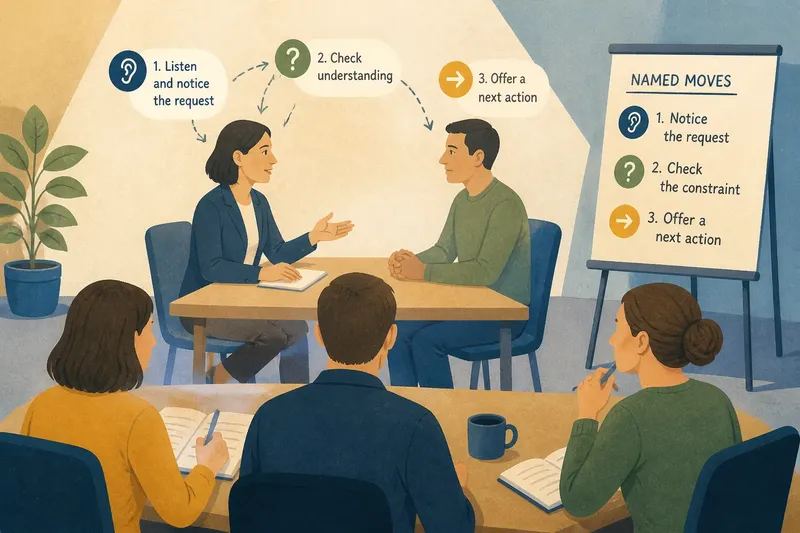
End with a shared next action, not an automatic compliment. That action might be another attempt, a short rehearsal, a check of a reference card or an agreed point to observe during the next task. Make clear what the learner will try and what evidence would show that the change is happening.
Say you are coaching a colleague who gives directions at a reception desk. They explain the route clearly but omit the landmark visitors need to find the correct corridor. You could agree that, during the next practice conversation, they will include the landmark and then ask the listener to repeat the route in their own words. The observable result is whether the listener can identify the corridor and recount the directions, not whether the trainer has delivered a perfectly balanced sandwich.
Where the learner’s own assessment differs from yours, record the difference as a question to revisit rather than forcing agreement on the spot. A later practice attempt can provide better evidence than a prolonged debate about one performance.
What should learners ask?
What if feedback is too vague?
Ask for the exact moment or action the trainer means, and request an example of what a clearer attempt would look like. “Which part should I change first?” can turn a general judgement into a manageable practice point.
Should every piece of feedback include praise?
No. Recognition is useful when it is genuine and relevant, but it need not appear in every conversation or occupy a set position. A direct, respectful correction with a clear reason can be more supportive than praise added to satisfy a formula.
What if I disagree with the observation?
Ask what the trainer saw and explain the context you believe matters. You can compare that account with the task requirements, then agree what to look for in another attempt rather than treating disagreement as proof that either person is wrong.
How much feedback should I act on at once?
Choose the point most closely tied to the current learning goal, especially if several changes have been suggested. You can ask which one would make the next attempt clearer or safer, then return to other observations later.
Why does relevance matter?
Feedback is most useful when it helps a person make a sound decision in the work itself. A fixed sequence cannot tell a trainer which detail matters, whether praise is sincere or what practice should follow. Specific observations can.
Before giving feedback, identify the task, the relevant expectation and the evidence you can describe. Then state the observation in ordinary language, explain its consequence where needed and agree a next action. The feedback sandwich can remind you to notice both strengths and gaps, but the learner needs something more substantial than a recipe: an honest account of the work and a clear way to improve it.