Handout or Worked Example: Two Ways to Support a New Skill
Handout or worked example? Match the material to what learners need next, so they can recall a process or apply it confidently at work.
The common mistake is handing out a summary when learners need to decide what to do with changing information. A handout or worked example serves different needs: one helps retrieve a known process; the other lets learners examine how a decision is made.
Different jobs
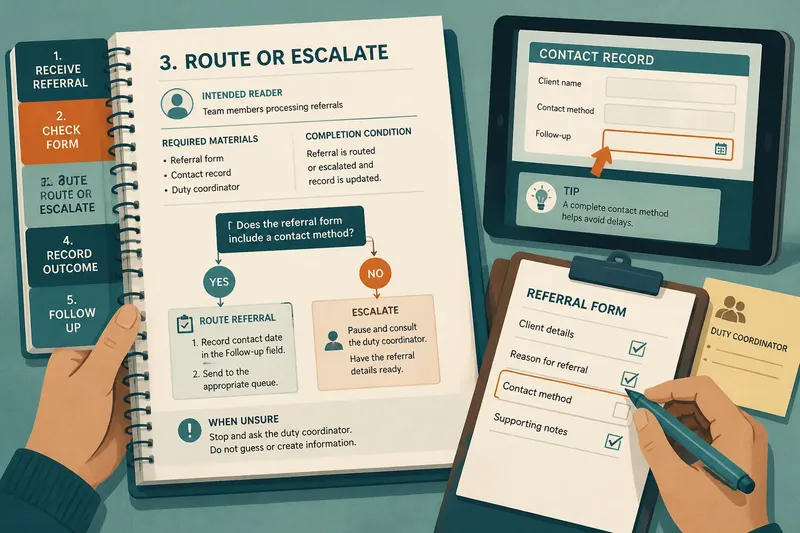
A reference handout is a compact prompt for information learners have already encountered. It might list task stages, essential checks or the details to record, arranged so someone can scan it during work.
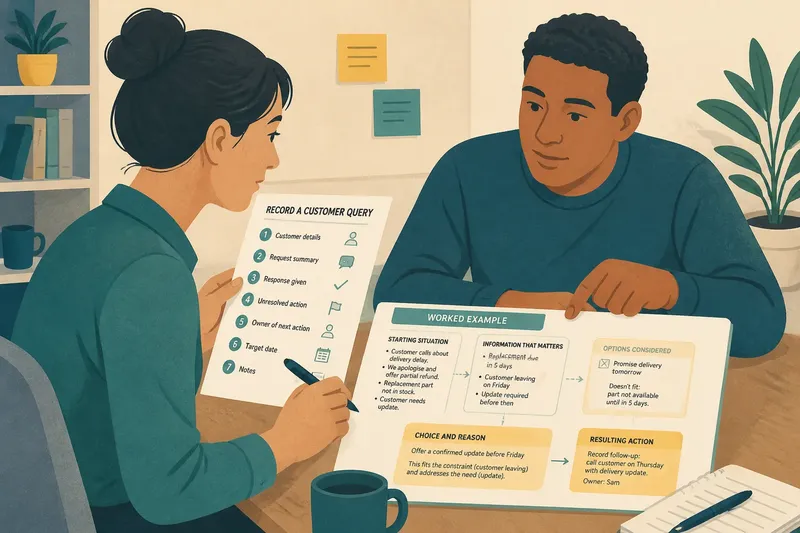
A worked example traces a task from its starting conditions to an outcome, making the choices and constraints visible along the way. Its purpose is not to provide a model answer to copy, but to show how particular information shapes the result.
The distinction is about the learner’s immediate difficulty, not the length of the material. A brief example can clarify one difficult choice; a longer handout can still fail if it buries the prompt someone needs.
Match the learning need
If learners can do a task but forget its sequence, give them a reference handout. If they can follow a sequence but cannot tell which action fits a changed situation, use an example that brings the relevant conditions into view.
Consider a handover note. A reference might prompt the writer to state the current situation, action already taken and next action. An example would be more useful if learners need to decide what to include when a colleague has incomplete information and must take over the work.
Say a facilitator is preparing new staff to log customer queries. The invented starting point is a call record with the customer’s request, the response already given and an unresolved follow-up. The facilitator first gives learners a concise handout listing the required record fields; they then use a worked example that highlights how to record the unresolved action and who needs to pick it up. The resulting trade-off is clear: the handout is quicker to consult during routine entry, while the example takes more attention but clarifies what to do when a record is incomplete.
Design a scannable handout
Put prompts in the order that work happens, use familiar terms and make each item point to an observable action. “Review the message” leaves the check unclear; “confirm that the next action has an owner” tells the reader what to look for.
Keep background explanation brief. If a term needs defining, add a short note beside it rather than letting explanatory text obscure the main sequence. Clear headings and spacing usually do more for a quick reference than decorative graphics.
- Check that the first prompt identifies where to begin; if it does, keep it at the top, and if not, rewrite it as a starting action.
- Check that each item names an observable action; if it does, retain it, and if not, replace vague wording with a specific check.
- Check that the sequence follows the actual task; if it does, preserve the order, and if not, rearrange the prompts to match the work.
- Check that unfamiliar terms are explained nearby; if they are, keep the definitions concise, and if not, add a brief explanation or use a familiar term.
- Check that a learner can spot the next action quickly; if they can, keep the layout, and if not, shorten the text or separate crowded groups.
- Check that the sheet prompts retrieval rather than introducing a new judgement; if it does, use it as a reference, and if not, move the teaching explanation into an example or session activity.
Shape a focused example
Choose a starting situation, the information that matters and the outcome learners should be able to explain. Show only the reasoning needed to understand the choice; routine actions that do not affect it can stay in the background.
Annotations can identify which information mattered and why another option did not fit. Avoid presenting a polished answer as though it appeared without choices. Where learners need to make their own judgement, leave a pause before revealing the next decision or result.
Imagine learners are practising responses to a scheduling conflict. The example could show a request, the relevant constraints, an option that does not fit and a reply proposing a workable next action. Learners can then consider a changed request and explain whether the same considerations still apply, rather than merely borrowing the wording.
Sequence the supports
For a process that is unfamiliar, introduce an example to clarify how the parts relate, then provide a compact handout for later reference. If learners already understand the reasoning, begin with the handout and move promptly into practice.
When a task has a stable sequence and few meaningful choices, a reference may be sufficient. When context changes what is appropriate, an example can make those differences easier to inspect. Using both works best when each has a distinct role: one explains a difficult decision; the other recalls the process.
It is not worth shrinking a full example into a crowded checklist or expanding a quick-reference sheet into pages of prose. Keep each material focused, and show learners when to consult it.
Check the fit?
When does a handout help most?
Use one when learners understand the task but need to recall its sequence, checks or required information. It should act as a prompt during work, not introduce a new decision that needs teaching.
What belongs in a worked example?
Include the starting situation, the information that shapes the choice and the resulting action. Make the connection between them clear without narrating every routine detail.
Can one resource serve both purposes?
It can, if the example and prompt list are visually distinct and each remains easy to scan. If combining them makes either function hard to find, use two complementary materials.
How can I check the material’s fit?
Give learners a fresh task and observe what they can do without additional explanation. If they retrieve the right sequence, the handout is serving its purpose; if they can explain why a choice fits changed conditions, the example has made the decision easier to apply.
When choosing a handout or worked example, start with the next obstacle learners are likely to meet. Keep a reference close to the point where someone must recall a process, and use an example when the conditions behind a choice need to be inspected; that distinction helps the material support work beyond the session.