A Quiet Review After the Workshop
A quiet review after the workshop helps learners capture what they covered, name open questions and choose what to revisit without turning reflection into a test.
The common mistake after a workshop is to spend the final minutes squeezing in one more topic. People leave with materials in hand but little time to separate what they understood from what still needs attention. A quiet review after the workshop gives that transition a purpose: it records the session’s useful threads without asking anyone to prove their learning.
Make room for reflection
Consider an invented situation. A facilitator has led a session for a small team of library staff on handling requests for accessible digital documents. The group has discussed how to clarify a reader’s needs, where to check document formats and when to ask a colleague for support. The planned session is nearly over, and several participants have questions about unusual file types.
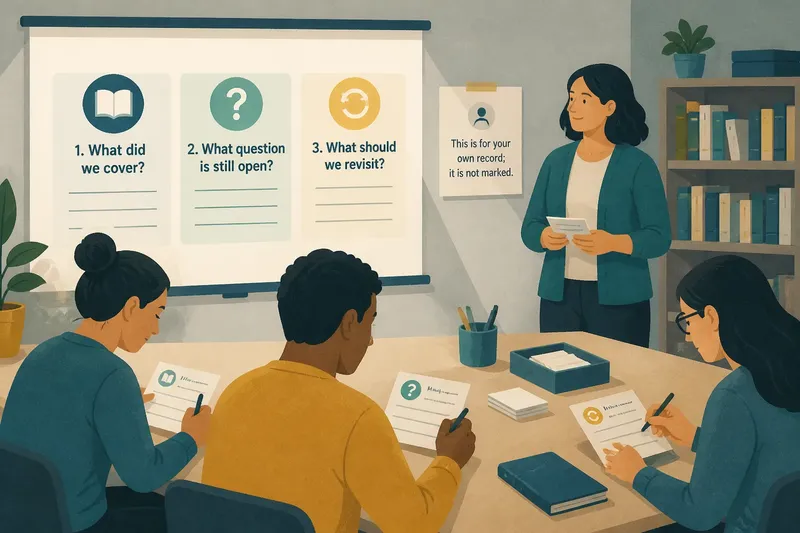
The facilitator could use the remaining time to recap every topic aloud. Instead, she leaves a short, quiet interval for each person to write down three things: what the session covered, what question remains, and what would be useful to revisit. The prompts are visible on a slide and printed on a plain card. Participants can write, draw a quick diagram or leave a prompt blank.
This is reflection, not assessment. An assessment asks for evidence against a standard, often to judge progress or decide what happens next. A review of this kind helps learners organise their own account of the session. It does not need a score, a model answer or a public round of reporting.
Keep the prompts distinct
Each prompt should do a different job. “What did we cover?” invites a brief record of the session’s main ideas or activities. “What question is still open?” makes uncertainty visible without treating it as failure. “What should we revisit?” identifies a topic, example or resource that may need another look.
These distinctions matter because broad questions can produce vague answers. “How did it go?” may invite a judgement about the facilitator or the room, while “What will you remember?” can make people search for a polished response. Concrete prompts keep attention on the learning material and make it easier to decide what to do with the responses.
In the library session, one participant might write that the group covered ways to clarify a request before choosing a file format. Their remaining question might concern a document with scanned pages. For revisiting, they might name the point at which a colleague should be consulted. Each note is useful without being a verdict on the participant’s competence.
Walk through the review
The facilitator introduces the activity in plain language: “Take a quiet moment to capture what is clear, what is still a question and what would help to see again. This is for your own record; it is not marked.” That last sentence reduces the chance that participants will guess what answer the facilitator wants.
She gives the group a few minutes, with no requirement to fill every line. The room stays quiet, but participants may look back at the session’s shared notes or their own handouts. The facilitator does not circulate to inspect responses. A learner who prefers not to write can keep the prompts in mind or make a private note on their own device.
When the interval ends, the facilitator offers a choice rather than calling on people in turn. Participants can keep their cards, hand them in without a name, or share one point with a partner. This protects the reflective purpose: a person can be candid about an unresolved question without making that uncertainty a performance for the room.
Suppose, in this invented situation, several anonymous cards mention uncertainty about scanned documents, while the notes about request clarification are more settled. The facilitator can acknowledge that pattern and say that the format question will be revisited in a later session or through a suitable reference resource. The cards show where attention may be useful; they do not establish that every participant has mastered the other material.
Choose what happens next
A review becomes less useful if notes disappear into a folder with no decision attached. The facilitator should look for themes that can shape a next session, a follow-up resource or a brief clarification. Individual questions can remain individual; not every response needs to become a group topic.
For the library team, the facilitator might add a short, clearly labelled note to the shared session record: scanned documents raised an unresolved question, so the next meeting should include a suitable example or a route for checking. She can also retain the broader topics that participants wanted revisited. The group’s notes inform planning, while the actual follow-up remains grounded in the work they need to do.
It is not worth the effort to turn every card into a complex coding system or to compare participants’ wording. The aim is to notice useful signals, not to create another reporting task. If the facilitator needs to assess performance for a separate reason, that requires a clearly explained process of its own, rather than quietly repurposing reflection notes.
Keep the routine humane
Some participants need time to think before they write; others may prefer not to disclose a question in front of colleagues. A quiet interval, optional sharing and a choice about whether to submit a note make room for those differences. The facilitator can also read the prompts aloud and leave them visible, so nobody has to rely on memory alone.
Keep the routine proportional to the session. A brief workshop may need only a few lines on a card; a longer session might use a page with space for topic names and questions. Avoid adding prompts about confidence, satisfaction or personal performance unless there is a clear reason and participants understand how the answers will be used.
For a quiet review after the workshop, the central decision is simple: treat the record as a guide to attention, not a measure of worth. In the library scenario, the unresolved file-format question points towards a useful follow-up, while the rest of the notes remain with learners as reminders of what they encountered. A modest review can close the session cleanly and leave the next learning task visible.
Questions facilitators ask
How long should the review take?
Give it enough quiet time for people to recall the session and write a few useful notes, without letting the activity become a second workshop. The appropriate interval depends on the session’s length, the complexity of its material and the group’s pace.
Should participants hand in their notes?
Not necessarily. Letting people keep their notes supports private reflection, while anonymous submission can help a facilitator spot recurring questions. Explain the choice and the purpose before people decide what to share.
What if nobody writes a question?
A blank question prompt does not mean that the session was complete or that participants understood everything. It may mean that no question came to mind in that moment; leave space for follow-up questions to emerge during daily work.
Can the review be used to grade learners?
It should not be treated as a grade when it has been introduced as reflection. If a separate assessment is needed, explain its criteria and purpose openly, and keep it distinct from this quiet closing routine.